TypeScript 7 Migration in Five Real Projects: tsc Got 3 to 6x Faster, the Rest of the Toolchain Still Runs on 6
 Samuel Santana
Dependabot opened a pull request on the React example in rx-state-bridge that took TypeScript from 5.6 straight to 7.0.2, and the build stopped on a line that had been there since day one:
src/main.tsx(4,8): error TS2882: Cannot find module or type declarations for side-effect import of './styles.css'.
I fixed it with the file Vite's own templates ship, a vite-env.d.ts containing /// <reference types="vite/client" />, and wrote in the commit that TypeScript 7 rejected the import. The fix was right. The explanation wasn't: 7 didn't invent that rule. I ran the same example, without vite-env.d.ts, on three versions:
TS 5.9.3                                       exit 0
TS 6.0.3                                       TS2882 on './styles.css'
TS 7.0.2                                       TS2882 on './styles.css'
TS 5.9.3 --noUncheckedSideEffectImports        TS2307 on './styles.css'
TS 6.0.3 --noUncheckedSideEffectImports false  exit 0
TS 7.0.2 --noUncheckedSideEffectImports false  exit 0
The error comes from 6.0, which turned noUncheckedSideEffectImports on by default. The PR skipped 6, and 7 inherited the new default. That is the single most useful fact for a TypeScript 7 migration, and the official announcement spells it out: 7.0 adopts 6.0's defaults and turns everything 6.0 deprecated into a hard error.
With that in mind, I took five of my public repositories, each at the last commit on main up to October 23, 2026, and ran every one through 5.9, 6.0 and 7.0: the type check, the timing, and every tool they use besides tsc.
What 7.0 Ships and What It Left for 7.1
7.0.2 has been the latest tag of the typescript package since July 8, 2026. It's the compiler rewritten in Go, with a native binary per platform (on Windows, a tsc.exe the package pulls in as an optional dependency) and parallel type checking. The announcement cites typical gains of 8 to 12x on full builds.
What it doesn't ship is the JavaScript API. The announcement is blunt: 7.0 "does not ship with an API", and the new API arrives in 7.1. In the package, that looks like this:
$ node -p "require('typescript')"
{ version: '7.0.2', versionMajorMinor: '7.0' }
On 6.0.3, the same require returns an object with 2,248 keys: createProgram, DiagnosticCategory, the whole compiler. On 7.0.2 it returns the version and nothing else. The 7.0.2 package.json does expose an API under typescript/unstable/sync, typescript/unstable/async and friends, but with unstable in the name, and none of the tools I tested use those paths. 7.1.0-beta, released October 20, ships the API under its final names (typescript/sync, typescript/async, typescript/ast...) plus an extension point for Vue, Svelte, MDX and the like.
Every tool that does require('typescript') to drive the compiler breaks on 7.0. For those, Microsoft published @typescript/typescript6, which re-exports the 6.0 API and installs a binary named tsc6, so both can live side by side. I'll come back to it in the toolchain section.
The Five Projects
| Project | What it is | TypeScript at the Oct 23 commit | Files in the program (TS 7) | Lines (TS 7) |
|---|---|---|---|---|
| rx-state-bridge | RxJS library (npm) | 5.9.3 | 279 | 75,090 |
| vertex-api | this blog's API, NestJS 11 | 5.9.3 | 2,774 | 334,152 |
| vertex-web | this blog, Next.js 16.3 | 5.9.3 | 1,704 | 375,155 |
| pyxis-api | Pyxis API, NestJS 12 | 6.0.3 | 4,109 | 527,120 |
| pyxis-web | Pyxis dashboard, Next.js 16.4 | 6.0.3 | 2,278 | 500,690 |
Line counts include the declarations from node_modules and TypeScript's own libs, which make up most of the program in any project. None of these is large: the biggest, pyxis-web, has about 110,000 lines of its own TypeScript. The announcement benchmarks 7 on VS Code, Sentry and Playwright; this is the size of project most of us actually maintain.
Two repositories were already on 6.0: the Pyxis ones, which started in October on 6.0.3. The other three were on 5.9. That difference decided almost everything that followed.
How Much Faster tsc Got
Full check (--incremental false), in seconds: median of 7 runs, with min and max.
| Project | 5.9.3 | 6.0.3 | 7.0.2 | 6.0 → 7.0 |
|---|---|---|---|---|
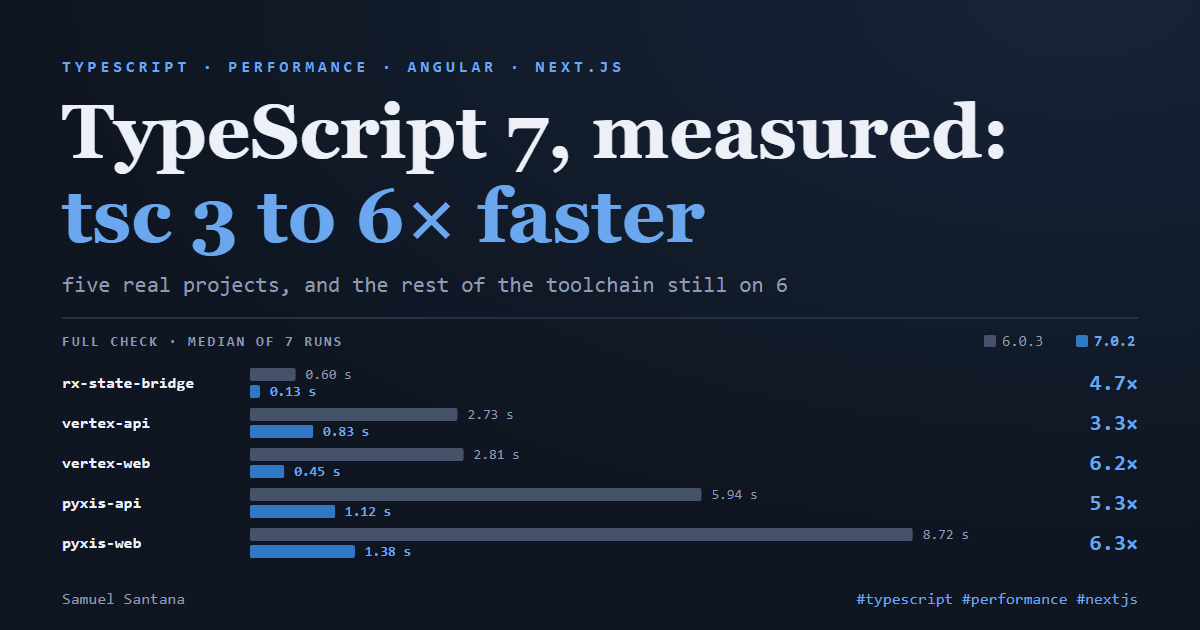
| rx-state-bridge | 0.59 (0.58–0.60) | 0.60 (0.59–0.61) | 0.13 (0.12–0.14) | 4.7x |
| vertex-api | 2.68 (2.65–2.71) | 2.73 (2.70–2.78) | 0.83 (0.82–0.85) | 3.3x |
| vertex-web | 2.81 (2.74–3.86) | 2.81 (2.75–3.68) | 0.45 (0.43–0.49) | 6.2x |
| pyxis-api | 5.94 (5.87–6.07) | 1.12 (1.07–1.16) | 5.3x | |
| pyxis-web | 8.72 (8.61–8.77) | 1.38 (1.35–1.42) | 6.3x |
Incremental, with no file changed since the previous run:
| Project | 5.9.3 | 6.0.3 | 7.0.2 | 6.0 → 7.0 |
|---|---|---|---|---|
| rx-state-bridge | 0.42 (0.41–0.43) | 0.41 (0.40–0.42) | 0.11 (0.11–0.11) | 3.8x |
| vertex-api | 1.65 (1.62–1.67) | 1.63 (1.60–1.65) | 0.38 (0.37–0.39) | 4.3x |
| vertex-web | 1.44 (1.41–1.47) | 1.46 (1.43–1.49) | 0.32 (0.32–0.33) | 4.5x |
| pyxis-api | 2.48 (2.44–2.50) | 0.57 (0.55–0.62) | 4.3x | |
| pyxis-web | 2.06 (2.02–2.17) | 0.43 (0.41–0.44) | 4.8x |
I measured tsc -p tsconfig.json --noEmit, every version on the same project, interleaved run by run: 7 runs per case, plus one discarded run to warm the OS file cache. "Full" uses --incremental false, checking the whole program from scratch. "Incremental" uses the .tsbuildinfo from a previous run with no file changed, which is what happens when you run tsc twice in a row in a project with incremental: true (all four apps have it). The machine is an Intel Core i9-13900H (14 cores, 20 threads), 32 GB, Windows 11, Node 24.19.0.
On a full check, 7 came out 3.3 to 6.3x faster than 6. That's well below the announcement's 8 to 12x, and --extendedDiagnostics helps explain why. On pyxis-web, 6.0.3 spends 6.71 s of its 9.06 s checking types; it's the project where checking dominates, and it's where 7 gained the most. vertex-api's program has 2,774 files, almost all of them declarations from node_modules, and 7.0.2 spends 0.35 s checking out of 0.75 s total; the rest is reading and parsing those files. My reading: the more of a project's time goes into checking, the closer it gets to the announcement's numbers. Small projects, or ones made mostly of third-party declarations, land in the 3 to 5x range.
From 5.9 to 6.0, timing doesn't move: it's the same JavaScript compiler with new defaults. The whole gain is in the jump to 7.
The incremental case is the one you hit all day, and there 7 was 3.8 to 4.8x faster. In absolute terms, rerunning tsc with nothing changed cost 1.5 to 2.5 s on the four apps with 6.0, and now costs 0.3 to 0.6 s.
Memory, from Memory used in --extendedDiagnostics: on pyxis-web, 912 MiB on 6.0.3 and 826 MiB on 7.0.2; on vertex-web, 447 and 293 MiB; the others go the same direction. The 6 number is the V8 heap and the 7 number is the Go runtime's, so the comparison is approximate; I didn't measure peak process memory.
The Parallelism Knobs
7 type-checks with four workers by default. --checkers changes that number, and --singleThreaded turns off parallelism everywhere, including parsing and emit. On pyxis-web, the largest of the five, in seconds (median of 7, min and max):
| Configuration | Time |
|---|---|
--checkers 1 | 2.05 (2.00–2.16) |
--checkers 4 (default) | 1.37 (1.30–1.41) |
--checkers 8 | 1.33 (1.30–1.38) |
--singleThreaded | 2.59 (2.50–2.70) |
Going from 4 to 8 checkers barely moved anything on a program this size, on a 20-thread machine. Even with a single checker, 7 was 4.3x faster than 6.0.3 (2.05 s vs. 8.72 s), because parsing and emit stay parallel; with --singleThreaded, which turns everything off, it was still 3.4x faster. For a CI runner with two or four cores, that says the gain doesn't depend on having lots of cores. I didn't measure on an actual runner.
On Windows, the package's tsc is a Node script that launches tsc.exe with execFileSync. Calling tsc.exe directly, without Node in between, gave a median of 1.33 s vs. 1.37 s through the regular tsc. About 40 ms, not worth changing any scripts.
The Errors 7 Reported, and Where They Came From
On the two Pyxis projects, already on 6.0.3, 7.0.2 reported no new errors. Same for the library and vertex-web. vertex-api, coming from 5.9.3, went from zero to 1,280 errors:
802 TS2304  Cannot find name 'expect' / 'jest' / 'beforeAll' / ...
412 TS2593  Cannot find name 'it' / 'describe' / 'beforeEach'
 49 TS2503  Cannot find namespace 'jest'
 12 TS7006  Parameter '...' implicitly has an 'any' type   (in .spec.ts files)
  2 TS2564  Property '...' has no initializer
  1 TS2345  Argument of type '...' is not assignable
  2 TS7022  '...' implicitly has type 'any' because it [...] is referenced [...] in its own initializer
6.0.3, on the same code, reports 1,278. The difference is exactly the two TS7022s, which get their own section below. Everything else is 6.0.
types Now Starts Empty
Up to 5.9, TypeScript automatically loaded every package under node_modules/@types. Since 6.0, types defaults to []. vertex-api's tests use Jest's globals (describe, it, expect), which come from @types/jest without any import, and 1,275 of the 1,280 errors were that: the first three codes in the list plus the 12 TS7006s, which are Jest callback parameters left without a type.
@types/node wasn't missed, and the reason is worth knowing: the code imports node:crypto, node:fs and so on, and Nest's dependencies reference Node's types. The package got into the program through imports. A global nobody imports, like Jest's, has no such path.
strict Is Now true by Default
The next three errors (TS2564 and TS2345) come from strict, which also became the default in 6.0. vertex-api's tsconfig turns on strict flags one at a time (strictNullChecks, noImplicitAny, strictBindCallApply) and never declared strict. With the new default, strictPropertyInitialization and strictFunctionTypes came along. For the migration I wrote "strict": false, which keeps exactly the 5.9 behavior. Turning on full strict mode is a separate decision, with its own PR.
rootDir Is Now the tsconfig's Folder
This one didn't fail tsc. It failed Jest. With the original tsconfig and the 6.0 API, all 30 test files failed before running:
error TS5011: The common source directory of 'tsconfig.json' is './src/auth/guards'.
The 'rootDir' setting must be explicitly set to this or another path to adjust your output's file layout.
  Visit https://aka.ms/ts6 for migration information.
ts-jest compiles each test file with the project's tsconfig, which has outDir. Up to 5.9, rootDir was inferred from the input files. In 6.0 it's the tsconfig's folder, and the compiler requires you to declare it when the input files don't match that folder. The Nest build's output layout didn't change: tsconfig.build.json already included the drizzle.config.ts at the root, so the output was already dist/src/main.js on 5.9 and stayed the same on 6 and 7 (I compared the list of emitted files across the three versions). Declaring "rootDir": "./" fixed Jest without touching the build.
The whole tsconfig migration fit in three lines:
     "outDir": "./dist",
+    "rootDir": "./",
+    "types": ["node", "jest"],
+    "strict": false,
     "incremental": true,
With them, 6.0.3 passes cleanly. 7.0.2 still reports two errors.
The Two Errors Only 7.0.2 Reports
The two TS7022s showed up in a function that pages through AWS Parameter Store in a do/while. 6.0.3 doesn't complain, not even with --stableTypeOrdering, the flag that makes 6 order types the way 7 does. 7.0.2 complains with any number of checkers, including --singleThreaded. So it isn't checking order.
I reduced it down to a file with no dependencies at all:
interface Item { name: string }
declare function send<T>(path: string): T;
declare const env: Record<string, string | undefined>;

export function load(prefix: string | undefined, more: boolean): void {
  if (!prefix) return;
  while (more) {
    const item = send<Item>(prefix);
    const name = item.name;
    if (env[name] !== undefined) continue;
  }
}
$ tsc --ignoreConfig --noEmit --strict g7.ts        # 6.0.3
(no output, exit 0)

$ tsc --ignoreConfig --noEmit --strict g7.ts        # 7.0.2
g7.ts(8,11): error TS7022: 'item' implicitly has type 'any' because it does not have a type annotation and is referenced directly or indirectly in its own initializer.

$ tsc --ignoreConfig --noEmit --strict g7.ts        # 7.1.0-beta
(no output, exit 0)
There's no circularity there. The ingredients are a union-typed parameter narrowed before the loop (prefix), a generic call using that parameter inside the loop, and an index access compared inside the same loop. The same family shows up in typescript-go issue #4673, opened July 19: the cause was a function ported from the old compiler (isMatchingConstructorReference) that ended up broader than the original. The fix landed July 21, after 7.0.2, and made it into 7.1.0-beta, which compiles the file above without errors.
Until 7.1 is stable, the way out is to annotate the type. In vertex-api, one line:
const page: GetParametersByPathCommandOutput = await client.send(
  new GetParametersByPathCommand({ /* ... */ }),
);
An error that only the new version reports, on code that didn't change, deserves a reduction before it turns into a code change. Here the annotation was harmless; reducing it is what showed the problem was in the compiler.
What 7 Turns Into Errors
If you're still on 5.x, the list in the 7.0 announcement is your checklist. Defaults that changed in 6.0 and hold in 7.0: strict: true, module: esnext, target set to the latest stable ECMAScript version, noUncheckedSideEffectImports: true, libReplacement: false, stableTypeOrdering: true (can't be turned off), rootDir at the tsconfig's folder, and types: []. And what was deprecated in 6.0 is an error in 7.0, with no ignoreDeprecations to fall back on:
target: es5anddownlevelIteration;moduleResolution: node(ornode10) andmoduleResolution: classic;module: amd,umd,systemjsandnone;baseUrl(pathsbecome relative to the tsconfig);esModuleInterop: false,allowSyntheticDefaultImports: falseandalwaysStrict: false;moduleinstead ofnamespaceto declare namespaces;assertson imports (usewith);/// <reference no-default-lib />underskipDefaultLibCheck;- file paths on the command line when the folder has a
tsconfig.json, unless you pass--ignoreConfig(hence the--ignoreConfigin the commands above).
The path the TypeScript team itself recommends is to go through 6.0 first. My numbers agree: on the two projects already on 6, 7 asked for nothing.
The Toolchain
tsc is the easy part. I installed typescript@7.0.2 in place of the previous version in each repository and ran what each package.json runs in CI:
| Tool | With typescript@7.0.2 | With the 6 alias + @typescript/native |
|---|---|---|
tsc (type check, pyxis-api build) | works | works (it's 7) |
ng build (Angular 22.2) | npm install refuses; forced, it breaks | works, on 6.0.3 |
next build (Next.js 16.3.8 and 16.4.2) | works, checks with tsc 7 | works, checks with tsc6 |
| typescript-eslint 8.x | breaks | works |
| ts-jest 29.4 | breaks | works |
nest build (Nest CLI 11) | breaks | works |
tsup 8.5.1 (.d.ts generation) | breaks | breaks; 9.0.0 works |
| Vitest | works | works |
"The alias" is the official recipe from the announcement:
npm install -D "typescript@npm:@typescript/typescript6@^6.0.2" "@typescript/native@npm:typescript@^7.0.2"
With it, typescript points to the compatibility package, and every tool that does require('typescript') gets the 6 API. 7 lives in @typescript/native, and npx tsc becomes its binary. The result, in one of the repositories:
$ npx tsc -v
Version 7.0.2
$ npx tsc6 -v
Version 6.0.3
$ node -p "require('typescript').version"
6.0.3
@typescript/typescript6 is at version 6.0.2, but it's a wrapper: it depends on typescript@^6 and installed 6.0.3. The tsserver in node_modules/.bin is also 6.0.3's.
Angular: 7 Stays Out of ng build
@angular/compiler-cli 22.2.3 and @angular/build 22.2.4 declare typescript as a peer at >=6.0 <6.1. npm takes that seriously:
npm error ERESOLVE unable to resolve dependency tree
npm error Found: typescript@7.0.2
npm error Could not resolve dependency:
npm error peer typescript@">=6.0 <6.1" from @angular/build@22.2.4
With --legacy-peer-deps it installs, and ng build breaks as soon as it tries to read the tsconfig:
✘ [ERROR] Angular compilation initialization failed. [plugin angular-compiler]

  TypeError: Cannot read properties of undefined (reading 'Error')
That's the compiler's ts.DiagnosticCategory.Error looking for an API that no longer exists. The message never mentions the TypeScript version, which is the worst part: whoever forces the install will go investigate something else.
With the alias, ng build works and produces the same bundle, same hash, as plain 6.0.3. What 7 gives an Angular project is a fast tsc -p tsconfig.app.json --noEmit, which is what the announcement recommends. But that tsc doesn't read templates. I planted an error in a template of rx-state-bridge's Angular example, a {{ name().toFixed(2) }} on a string | null signal:
$ npx tsc -p tsconfig.app.json --noEmit     # 7.0.2
(exit 0)

$ npx ng build
✘ [ERROR] TS2531: Object is possibly 'null'. [plugin angular-compiler]
✘ [ERROR] TS2551: Property 'toFixed' does not exist on type 'string'. Did you mean 'fixed'? [plugin angular-compiler]
tsc 7 works as a fast check of the TypeScript code in a pre-commit hook or at the start of a pipeline. It doesn't replace ng build or ng test as the type check of an Angular project, because half of a component's types live in its template.
Next.js: next build Already Runs tsc as a Process
This was the result I didn't expect. Next.js 16.3.8 (vertex-web's version on October 23) and 16.4.2 (pyxis-web's) already ship with experimental.useTypeScriptCli on by default. Instead of loading the TypeScript API, next build runs the project's tsc as a separate process. The docs say this is precisely to support 7 while it has no API.
With typescript@7.0.2 installed, vertex-web's next build passed, and a type error I planted on purpose came out the way tsc prints it, without the code frame Next usually builds:
  Running TypeScript ...
src/lib/site-url.ts(20,14): error TS2322: Type 'string' is not assignable to type 'number'.
Failed to type check.
Turning the option off (useTypeScriptCli: false) with 7 installed, Next stops with a clear message:
TypeScript 7.0.2 does not provide the compiler API required by Next.js. Set experimental.useTypeScriptCli back to true in your Next.js config to use the TypeScript CLI, or install TypeScript 6 instead.
The detail that changes the decision shows up with the alias. Next finds tsc by reading the bin field of whatever package answers for typescript/package.json, and it accepts a binary named tsc followed by a number. With the alias, that package is @typescript/typescript6, the binary is tsc6, and next build checks with 6.0.3. To prove it, I dropped the TS7022 file from the previous section into vertex-web's src: with the alias, next build passed ("Finished TypeScript"), and npx tsc (7) reported TS7022 on the same code.
So, in a Next.js project with typescript-eslint, as of October 23 you get one of two things: next build checking with 7 and lint broken, or lint working and next build checking with 6. I went with the second and run tsc 7 as a separate CI step. If you want 7 inside next build, you can turn off Next's check (typescript.ignoreBuildErrors) and keep only the tsc 7 step, but that removes the safety net for anyone running next build on their own machine. I didn't do it.
What that's worth for the whole next build: I measured with each repository's locked TypeScript and with typescript@7.0.2, 5 builds per configuration, .next deleted before each one (median, min and max, in seconds).
| Project | "Running TypeScript" step | Whole next build |
|---|---|---|
| vertex-web, 5.9.3 | 3.0 (3.0–3.0) | 9.3 (9.2–9.4) |
| vertex-web, 7.0.2 | 0.66 (0.63–0.69) | 7.1 (7.0–7.2) |
| pyxis-web, 6.0.3 | 9.1 (9.0–9.1) | 15.0 (14.9–15.4) |
| pyxis-web, 7.0.2 | 1.75 (1.66–1.77) | 8.1 (7.8–8.2) |
On pyxis-web, the whole build dropped by almost half, because type checking was more than half of it. On vertex-web, checking was already the smaller part, and the build got only 2 seconds shorter. That's the gain you leave on the table when the alias makes next build use tsc6.
typescript-eslint, ts-jest and Nest CLI: They Need the API, and They Say So
All three load the compiler as a library. typescript-eslint, since 8.63.0 (July 6, two days before 7.0), detects 7 and stops:
typescript-eslint does not support TS 7.0.
Please see https://devblogs.microsoft.com/typescript/announcing-typescript-7-0/#running-side-by-side-with-typescript-6.0 to run typescript-eslint using the TS 6 API.
See also https://github.com/typescript-eslint/typescript-eslint/issues/10940 for tracking typescript-eslint's support for TS >=7.1
8.62.1, one version earlier, doesn't have that check. In vertex-api, which was on it, ESLint crashed with TypeError: Cannot read properties of undefined (reading 'Cjs'), from inside @typescript-eslint/typescript-estree, without saying why. The declared peer is typescript >=4.8.4 <6.1.0 on all of them, and npm handles it two ways. In pyxis-web, where typescript-eslint is a direct dependency, npm install -D typescript@7.0.2 stops with ERESOLVE, same as Angular. In vertex-web, where it comes in through eslint-config-next, npm only warns ("overriding peer dependency") and installs, and the problem only shows up when someone runs lint.
ts-jest 29.4 (peer typescript >=4.3 <7) and Nest CLI 11.0.24 also explain what happened:
The TypeScript compiler "typescript" (version 7.0.2) does not expose the JavaScript compiler API required by ts-jest. To use TypeScript 7 for project type-checking, install it as "@typescript/native" and alias "@typescript/typescript6" as "typescript" for ts-jest.

Error  The installed TypeScript version (7.0.2) does not expose the programmatic compiler API that the Nest CLI requires. TypeScript 7.0 ships the "tsc" executable only; the compiler API is expected to return in 7.1. Please install TypeScript 6 (e.g. "npm i -D typescript@^6") until then.
With the alias, all three worked again. In vertex-api, though, they worked again on 6.0, and 6.0 has the new defaults. Before I fixed the tsconfig, ESLint, which runs type-aware rules, reported 3,554 errors: no-unsafe-call, no-unsafe-member-access and no-unsafe-assignment on every expect(...) and jest.fn(), because without types: ["jest"] those names have no type. The three tsconfig lines fixed lint along with tsc and Jest. With them, vertex-api had tsc (7), nest build, 248 tests and lint all passing.
tsup: The Problem Was the baseUrl It Injects Itself
rx-state-bridge generates its .d.ts files with tsup. With 7 installed directly, declaration generation broke with Cannot read properties of undefined (reading 'useCaseSensitiveFileNames'), from inside the rollup-plugin-dts that tsup bundles. Expected: one more API consumer.
With the alias, it broke differently:
error TS5101: Option 'baseUrl' is deprecated and will stop functioning in TypeScript 7.0. Specify compilerOption '"ignoreDeprecations": "6.0"' to silence this error.
The library's tsconfig has no baseUrl. tsup 8.5.1 adds it, building the declaration options with baseUrl: compilerOptions.baseUrl || ".". tsup 9.0.0, from October 14, no longer does that: with it and the alias, generation passed, the JavaScript came out byte-for-byte identical to 5.9.3's, and the .d.ts changed only in the shape of the final export (9 splits export type { ... } onto its own line).
What Needed Nothing
Vitest runs on both front-end repositories with 7 installed and never notices, because it transforms TypeScript without going through the compiler. Same for the Vite build in the React example. pyxis-api compiles with tsc -p tsconfig.build.json, so its production build started using 7 without changing a line; vertex-api compiles with nest build, which needs the API, and stays on 6.
What Changes in dist
I compared 6.0.3's output with 7.0.2's on both backends. In pyxis-api, 17 of 601 .js files differed; in vertex-api, 7 of 90. In every case, the difference disappears when you ignore whitespace and line breaks: 7 wraps decorator metadata arrays at a different point. The code is the same.
The .d.ts files change more: 21 files in vertex-api, with properties in a different order. That's stableTypeOrdering, which 7 always applies. For an application, it doesn't matter. For a library that versions its declarations or diffs dist across versions, the first 6-to-7 diff will be large and will mean nothing.
The package.json I Ended Up With
In every repository I tested, the setup that passed everything was the same:
{
  "devDependencies": {
    "@typescript/native": "npm:typescript@^7.0.2",
    "typescript": "npm:@typescript/typescript6@^6.0.2"
  }
}
The project's tsc is 7, and it's what runs in the typecheck scripts. Everything else (Angular, Next, ESLint, Jest, Nest) gets 6, including ng build and next build. The gain lands in the CI type-check step and in the pre-commit hook, the two places where I wait on the compiler the most.
What I didn't measure: the editor. 7 has its own language server and doesn't run language service plugins, which includes the Next plugin declared in the tsconfig and Angular's template checking in the editor. I tested neither. And none of these projects comes close to the size of the ones in the announcement; in a monorepo with millions of lines, the ratio between process startup and checking time changes, and the numbers above say nothing about it.
Once 7.1 ships with a stable API, the alias stops being necessary for tools that adopt it. 7.1.0-beta already has the API and the TS7022 fix. Until then, each tool on the list above has to publish a version that uses the new API, and that's what I'll be tracking, one by one, before dropping the alias.
Comments
Loading comments...