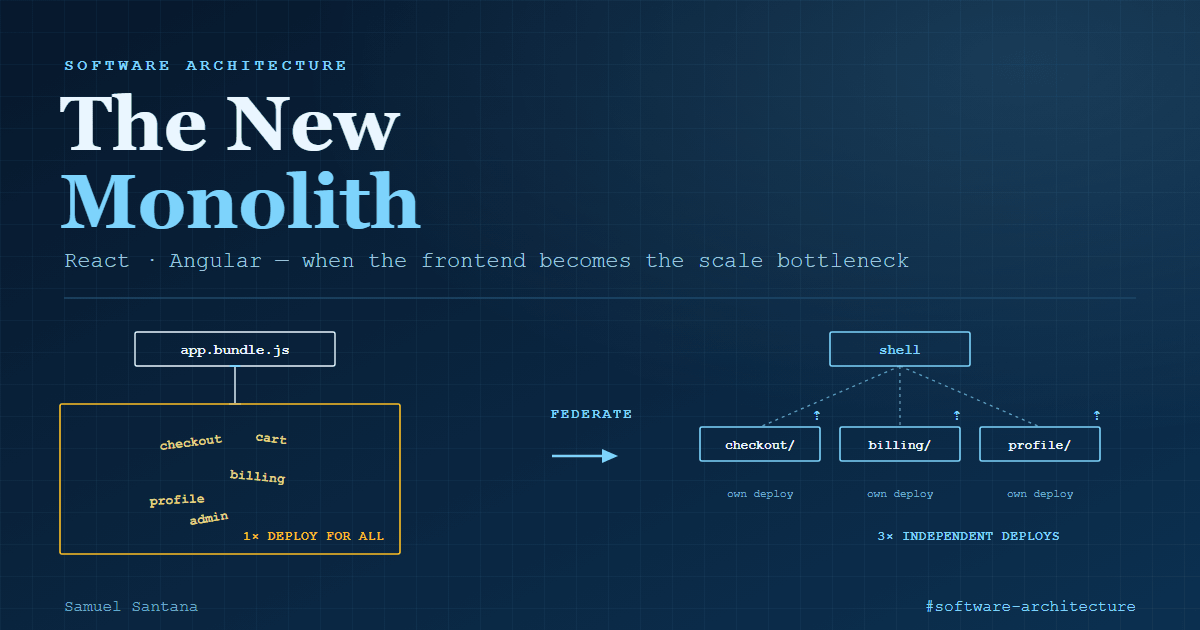
Has the Frontend Become the New Monolith? How Architecture Impacts Business Scale
 Samuel Santana
For a long time, the term "legacy monolith" was a nightmare exclusive to backend teams. But as the complexity of modern web applications grew, business logic, state management, and routing rules migrated in force to the browser. The result? The frontend became the new scalability bottleneck at companies.
When an application grows organically without a solid architectural foundation — especially in multi-tenant SaaS environments — what was supposed to be a quick feature delivery turns into a minefield of bugs and regressions.
So how do we solve the frontend monolith problem? The answer isn't switching frameworks, but applying classic Software Engineering principles on the client side.
1. Breaking Down Boundaries with Micro-frontends
Adopting Micro-frontend architectures stopped being a "buzzword" and became a serious option for large teams. The core idea is simple: split a giant application into smaller, independent business domains.
With technologies like Module Federation, we can build applications where different teams develop, test, and deploy their parts (like the payments dashboard or the user profile module) in complete isolation, integrating everything at runtime. This cuts each part's build time and the merge conflicts between teams — at a real cost: duplicated dependencies in the bundle, shared versions negotiated at runtime, and more operational complexity. For a small team, a well-organized modular monolith usually solves the same problem with fewer moving parts.
2. Decoupling and Dependency Inversion
A common mistake in React and Angular projects is tightly coupling business rules to visual components. When the UI knows too much about how data is fetched or processed, testing becomes a nightmare.
Resilient applications separate the presentation layer from the domain layer. Keeping the rules in plain, framework-free TypeScript modules — exposed to the UI through dependency injection or thin custom hooks/services — ensures that, if the UI library changes tomorrow, your crucial business rules stay intact; only the thin hook/service layer gets rewritten.
3. The End of "Cascading Renders" with Modern Reactivity
Performance is a business metric. A sluggish system directly hurts user retention. In recent years, the way the frontend handles reactivity has changed considerably.
Adopting patterns like Signals — which deliver fine-grained reactivity — lets the framework update only what depends on the changed value — in Angular, the components that read that signal; in libraries like SolidJS, the exact piece of the DOM — without needing to re-render entire component trees. That cuts much of the work wasted on re-renders and helps keep dense interfaces with lots of real-time data smooth.
Conclusion
Clean code and good frontend architecture aren't just technical vanity; they're leverage tools. They let new people join the team and ship sooner (fast onboarding), let deploys happen without fear of taking down the whole system, and let the product pivot quickly without needing a rewrite from scratch.
True seniority in frontend engineering isn't memorizing a tool's documentation — it's understanding which architectural problem it solves.
Comments
Loading comments...